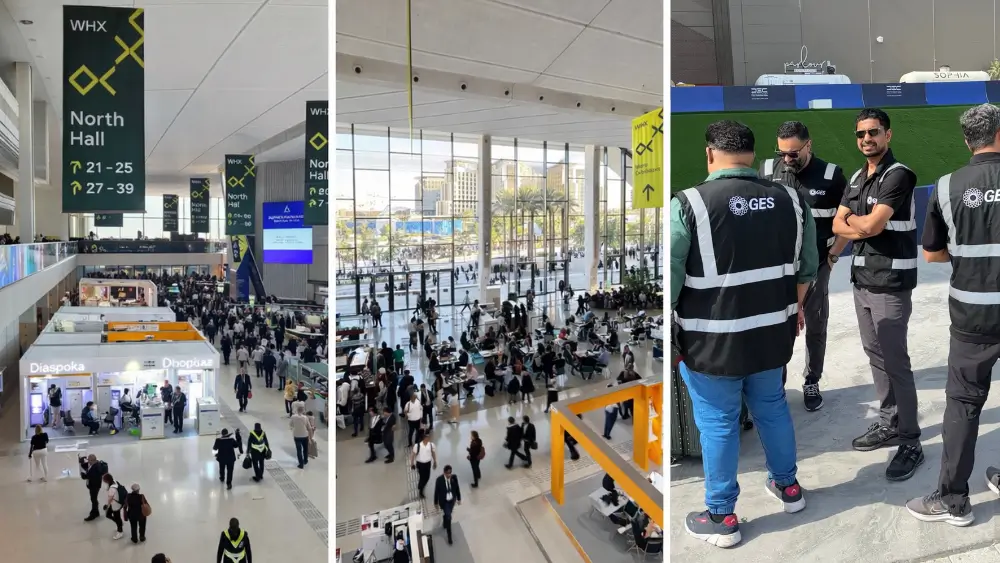
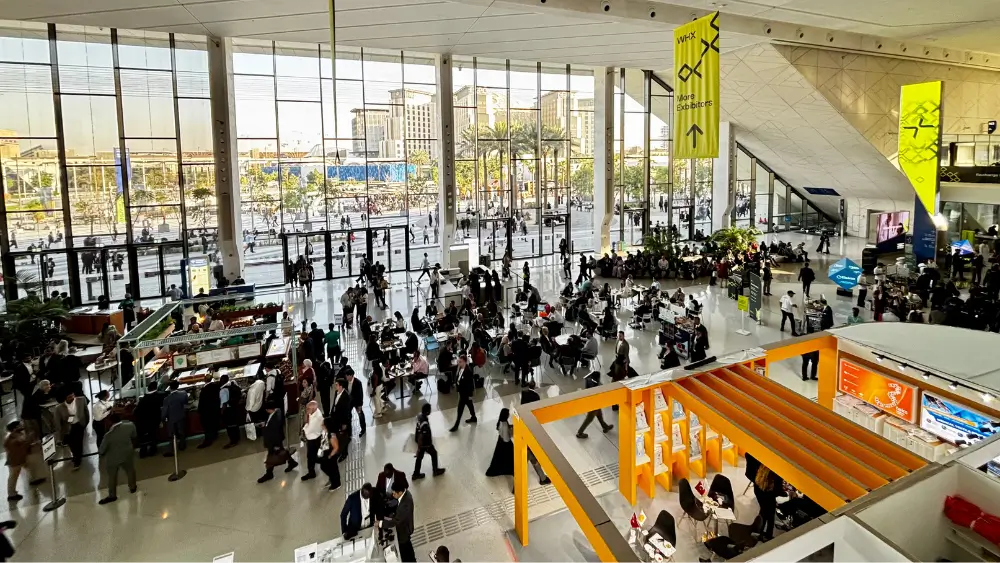
Opening day… 100,000 attendees expected across seven locations. A new commercial model, paid admission for the first time in six years, tied directly to gate performance.
On opening morning, I watched a bottleneck develop at the entry.
What happens in the next thirty minutes determines whether the event is remembered for the right reasons. I knew that, and every member of the team on the floor knew that. At World Health Expo Dubai, that window closed cleanly and what made it close cleanly is worth explaining for anyone responsible for access control at scale.
The full picture of what was built and what it delivered commercially is documented in the WHX Dubai 2026 case study. But for a quick depiction of the event, take a look at the video below.
When the Gate Becomes Revenue Protection
For most of WHX Dubai’s history, entry was free. Access control was straightforward: validate credentials, manage flow, maintain records. Competent work, but operationally routine.
This edition was different, as every attendee arriving at those entry points had completed a purchase. The system had to verify ticket type, confirm zone-level permissions corresponding to commercial tiers, and enforce those rules consistently across seven entry points for seven days. A misconfigured rule is either a paying attendee blocked at a door they have already paid to open, or a revenue leak that compounds with every scan.
Neither outcome is recoverable mid-event, and both are a breach of trust with the people who paid to be there.
When the commercial model is tied directly to gate performance, access control becomes revenue protection. The access control solutions supporting it need to be engineered with that consequence in mind.
The Configuration Behind 100,000 Entries:
Access Control at Scale
The structural complexity of this edition was considerable. The co-location of WHX Labs created distinct visitor categories with distinct access rights. Supporting this required more than 50 registration types, over 100 purchasable items, and 200-plus individual access rules, each mapped precisely to commercial tiers, visitor categories, and zone-level permissions across seven entry points.
Abdul Aleem and Zulfikar Shareef from our team built that architecture. What they brought to it was not just their technical skills but six years of working for this same show. They knew how WHX Dubai operates commercially, how the venue is structured physically, and where edge cases tend to appear under live conditions.
A briefing document can’t replicate that. The rules our team designed were built by people who understood what was at stake if those rules were wrong.
Alongside the access rule architecture, hybrid badging was introduced for the first time: printed credentials operating in parallel with the digital badges used in previous editions. That required parallel processing capability at all entry points and a clear operational protocol for handling both credential types under live load.
Opening Day: What Actually Happened
The first morning of any large-scale event carries variables that cannot be fully modelled in advance. Visitor arrival patterns, queue behaviour at specific terminals, and the ratio of credential types presenting at each point are estimable, not predictable.
I was on the floor when congestion developed at the entry points. The volume of attendees presenting printed badges exceeded what the initial terminal configuration could process at the pace we needed. Queues grew faster than they should have. At this scale, delays of even a few minutes can cascade across multiple entry points and become difficult to recover within the same day.
The decision was straightforward: allow digital credentials to process in parallel with printed badges, removing the constraint immediately. Flow stabilised. No structural change to the access model was required, and nothing escalated to the organiser’s leadership. Twenty additional check-in terminals would have helped. But that is a lesson carried into next year.
From an attendee’s perspective, it was a busy opening morning. From where I was standing, it was a live access control adjustment, resolved before it became visible to anyone outside the team.
Across the full seven days, 70 fixed check-in terminals and 120 smart scanners operated across the seven venue locations, supported by 129 Check-in Lite licences at manual access points. After the day-one adjustment, the event ran without incidents.
What This Means for Event Directors
When events reach this level of scale and complexity, access control stops being a technical function and becomes an operational risk factor. A misconfigured rule in a free-admission environment is a minor correction. The same error in a paid-admission model with 200-plus permission tiers is a financial and reputational exposure.
The difference lies in how the platform is configured, how quickly it can be adapted under pressure, and whether the team operating it understands the event well enough to make decisions in real time, without waiting for approval.
At WHX, that capacity was tested on day one and held.
For organisers evaluating event management platform options, that reframes the criteria. Reference checks should ask not whether the platform performed, but what happened when it did not, and how fast the resolution came. The quality of support during evaluation is the strongest available predictor of support quality on event day. Configuration quality and response capability matter as much as the feature set.
The speed of that response at WHX came from a team that knew the venue, held the relationships, and had the authority to act. None of that appears on a feature comparison sheet.
Why Six Editions Matter
“The guidance on what works, what creates impact, and how to improve each year, that accumulated knowledge matters enormously.”
– Steffi Johnson, Operations Manager, WHX Dubai –
There is a category of operational knowledge that does not transfer by documentation. Technical skill can be trained, and platform familiarity can be acquired. What takes longer to build is an understanding of how a specific event behaves, how the organiser makes decisions under pressure, which problems tend to surface at which points in the show’s cycle, and where the edge cases appear.
Working alongside Informa across multiple editions means that understanding is continuous. Each year at WHX builds on the last. When something unexpected happens, and something always does, the distance between noticing it and resolving it is shorter, because the context is already held by the people on the floor.
Continuity between organiser and technology partner is not a soft benefit. In large-scale event management, it is a risk management tool.
On-the-Ground Reality
Over seven days, our team logged 1,134,000 steps across the seven venue locations. The daily average was 18,000 steps per person.
Those numbers reflect where we were positioned: on the floor, distributed across all locations, close enough to conditions to catch problems before they compounded. Support that operates remotely is a different product. In on-site event technology, distance from the floor is distance from the problem. That is what industry-leading support at scale actually looks like in practice.
Large-scale events impose physical constraints that staging environments do not replicate. Outdoor registration points in 40-degree heat affect printer tolerances. Slightly heavier badge stock causes processing malfunctions. Network performance shifts when peak arrivals compress into the same window. A team with multiple editions on the same show has encountered these variations before, and carries the solutions.
The Quiet Measure of Success
The measure of a well-run event operation is, in a specific sense, silence. When the infrastructure works, nobody mentions it. 100,000 attendees move through entry, find sessions, engage with exhibitors, and leave with the impression that everything simply worked.
The pre-dawn terminal checks, the 200-plus access rules precisely mapped to a paid-admission commercial model, the day-one adjustment resolved before queues became a story: none of this surfaces in the attendee experience. Which is exactly as it should be.
WHX Dubai closed its seventh day with the hybrid badge model performing as designed, paid access enforced accurately across all visitor categories and zones, and the co-location with WHX Labs operating cleanly within the broader access architecture. The revenue model was protected. The attendee experience was uninterrupted.
Precise configuration, six years of accumulated institutional knowledge, and a team that stayed close enough to catch what could not be planned for: that is what keeps a complex event running without incident, even when conditions do not follow the plan.
Meet the Author
-
Support ManagerView all posts
Ali has spent more than a decade in event technology, working his way to leading onsite operations across Europe, the Middle East, Asia, and North America. Based in Dubai, he manages registration systems, access control infrastructure, and live event deployment for large-scale exhibitions. His writing draws on what he observes on the event floor. Real event life. Real operations challenges.